

How to Build a Retirement Portfolio That Survives a Market Crash
Your 8% income fund may be shrinking your savings. Real 10-year numbers, a 3% vs 8% withdrawal test, and the retirement mistakes to avoid.
In almost every first conversation I have with someone close to retirement, one question comes up early: how much can I safely take out each year? Most people expect the answer to be 6% to 8%, because that is what a fixed deposit pays, or what their fund pays out: if the money earns 7%, taking out 7% feels safe. What gets missed is inflation. Take out everything the money earns and the capital never grows, while the same lifestyle costs more every year. Indian prices rose about 59% in the 10 years to 2025. After 10 or 15 years, the withdrawal that felt safe no longer pays for the life it was meant to. The honest answer is lower, and this article explains why.
If you are planning retirement from the UAE, whether you will stay, move back to India or settle somewhere else, the same risk applies. Saving enough is only half the job. The other half is making sure your money keeps paying for your life when markets don't cooperate.
The biggest risk is simple to describe. Markets fall in your first years of retirement, and you still have to take money out. Every withdrawal during a fall sells more of your investments at low prices, and those units are not there when markets recover.
1. Understand the Risk of Withdrawing During a Market Crash
Two people can retire with the same savings and earn the same average return, yet end up with very different amounts. The one who meets a crash first, while withdrawing, is left with far less. This is called sequence-of-returns risk.
Here is what it looks like with real Nifty 50 numbers. Say you retired in January 2008 with ₹1 crore in the Nifty, right before it fell 60%. It took 34 months to get back to its old high.
- Take out ₹8 lakh in the first year, raised each year with Indian inflation, and the money ran out in November 2015, after about eight years.
- Take out ₹3 lakh instead, and you would still have about ₹1.20 crore in September 2025.
The average return was not the problem. From that January 2008 peak to September 2025, the Nifty 50 returned about 9.3% a year, including dividends. That is more than 8%, yet the 8% plan still ran out, because the crash came first.
2008 was not a one-off. Since 2000, the Nifty has fallen 20% or more seven times. Pick any of them below and see what happened to ₹1 crore.
Taking 8%, the money ran out in four of the seven crashes, within 8 to 13 years. Taking 3%, it came through all seven and grew.
A retirement plan should assume at least one crash like these will arrive while you are drawing on your savings.
2. Keep Short-Term Expenses Away From Market Volatility
Keep about 2 years of essential spending away from the stock market. In a crash, you live on that and leave your investments alone. In the example above, that is about ₹6 lakh, so nothing has to be sold while the Nifty is down 60%.
That money should not all sit in a savings account, where inflation eats it. A common rule is to spread it by when it will be needed: cash for the next 3 months, liquid funds for months 3 to 6, and ultra-short and short-term debt funds for months 6 to 24.
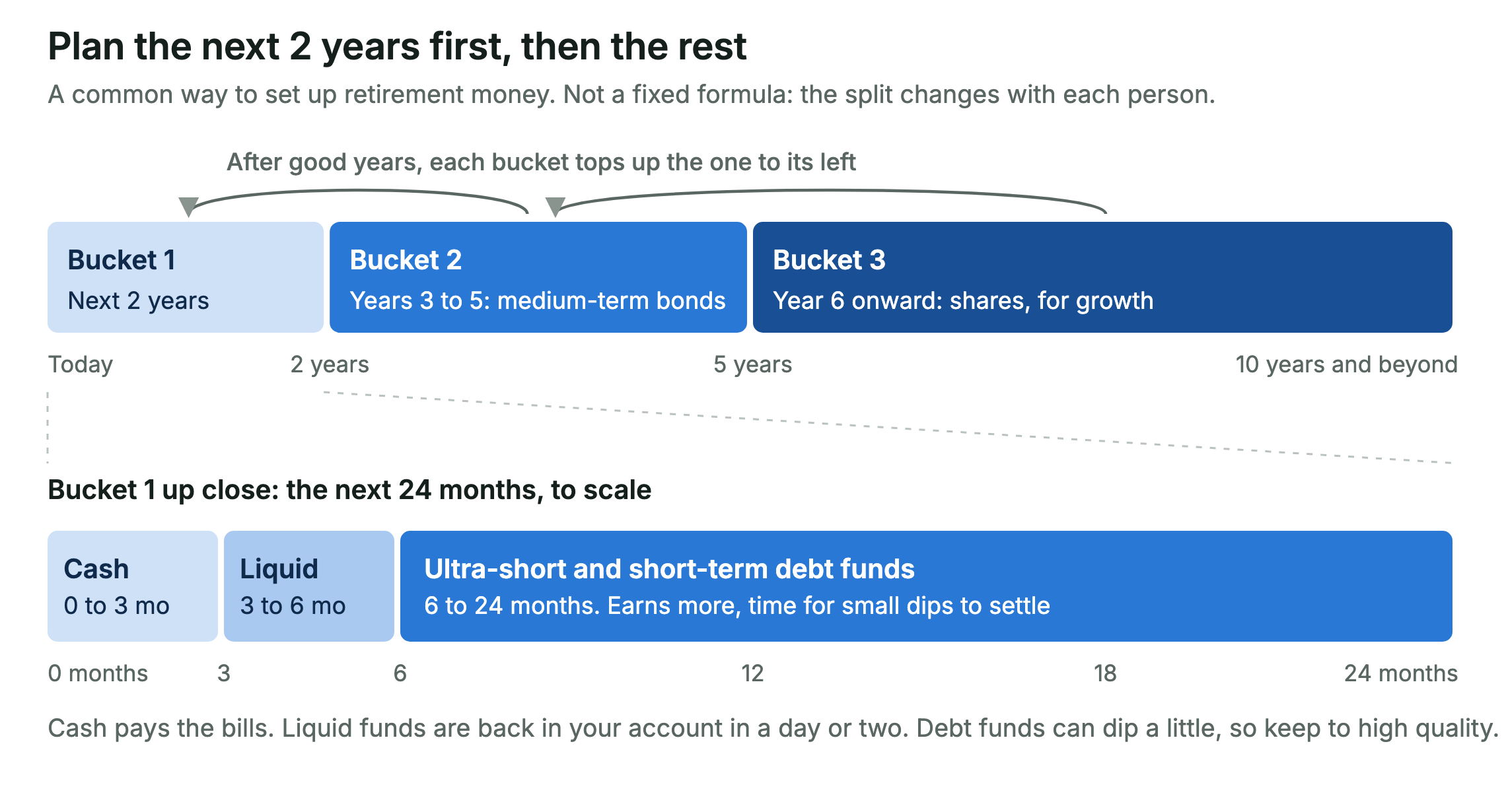
After a good year in markets, move money from your investments to top this back up to 2 years. After a bad year, let it run down and sell nothing.
Liquid and short-term debt funds are not bank deposits. Their value can dip a little, so keep to high-quality funds. If you spend in dirhams, the same idea works with a current account, money market funds and short-term deposits.
3. Build a Portfolio With Different Roles
Once the next 2 years are covered, build the rest the other way around, starting from what each part has to do:
- Bucket 1: cash and short-term debt for the next 2 years, as above.
- Bucket 2: high-quality medium-term bonds for years 3 to 5, to refill bucket 1 when shares are down.
- Bucket 3: shares for year 6 onward, to grow and keep you ahead of inflation over a long retirement.
The crash chart in section 1 uses shares alone, to show the fall clearly. Bonds and cash soften the fall. They do not make an 8% withdrawal safe.
These periods are a common rule, not a fixed formula. How much goes in each bucket depends on what you spend, your other income and how you would feel in a fall. Working with a qualified adviser gives you a second opinion, and the plan can be reworked as your situation changes.
4. Keep Your Withdrawals Safe
This is the decision that matters most, and the one most often got wrong. A safe withdrawal is one you can keep taking through a bad decade without running out.
That is why we start at about 3%. We stress-tested withdrawals against all seven Nifty crashes since 2000, retiring at the top each time. Taking 3% a year, raised with inflation, the money lasted through every one. Taking 8%, it ran out in four of them.
3% can sound low, but it is about what a flat pays in rent. Take a typical 2BHK flat in Bengaluru: it costs about ₹1 crore and rents for about ₹25,000 a month. That is ₹3 lakh a year, or 3%, the same as a 3% withdrawal from ₹1 crore. Delhi, Hyderabad and Mumbai work out much the same. After maintenance, property tax and months without a tenant, the flat pays closer to 2%. Few people expect a flat to pay them 8% a year.
You also cannot choose which year you retire into. Returns may be lower over the next 25 years, recoveries can take three or four years, and a retirement portfolio holds less in shares, so it earns less than the Nifty did. No withdrawal rate is guaranteed to be safe, but 3% leaves room for a bad decade.
A high monthly payout is a withdrawal too
Many people in the UAE hold funds that pay about 8% a year, every month. That payout is a withdrawal. If the fund earns less than it pays, the difference comes out of your capital.
Here is one popular monthly-income fund, followed from the start of 2016 with the income spent. The fund is priced in dollars, so we show it for every 100 invested, in any currency:
| Year | Income for every 100 invested | What happened |
|---|---|---|
| 2016 | 9.9 | The starting point |
| 2018 | 8.9 | Fund fell 4.9% |
| 2022 | 8.1 | Fund fell 19.7%; payouts kept going |
| 2025 | 7.4 | Income a quarter lower than in 2016 |
Source: the fund's published payouts per unit and annual returns. Past performance does not predict future returns.
Look at 2022. The fund fell 19.7%, yet the same payout kept going out, so more of each payment came from capital at low prices. Afterwards the payout was cut. After 10 years, each 100 invested was worth about 95, and about 69 after inflation, even though the fund returned about 8% a year.
Read the full 10-year breakdown: Why an 8% Monthly Payout Can Shrink Your Retirement Savings
5. Rebalance Instead of Reacting Emotionally
Decide your mix in advance, and rebalance back to it once a year. That way you trim shares after good years and add back after falls, instead of selling in a panic. In a year like 2008, that means buying shares when it feels worst.
6. Account for Inflation and a Longer Retirement
Retirement can last 25 to 30 years. As we saw at the start, prices rose about 59% in 10 years. That is why the withdrawals in our chart rise every year: what costs ₹3 lakh today will cost far more in 2040. A portfolio built only for safety, or only for a high monthly income, slowly loses buying power.
7. For NRIs, Retirement Planning Needs a Cross-Border Perspective
- Match each part of your money to the currency you will spend it in.
- Your end-of-service gratuity is the nearest thing to a pension. Decide what it is for before it arrives.
- Employer health cover usually ends with your job. Budget for it.
- If you return to India, the RNOR window can matter for taxes. Confirm your position with a qualified tax adviser.
What Drains a Retirement Corpus Faster
- Withdrawing too much. In our Nifty examples, 8% a year ran out within 8 to 13 years in four of seven crashes.
- Treating a payout as income. A high payout from a fund that earns less is your own capital coming back.
- Selling in a crash. Without 2 years of spending set aside, you are forced to sell low.
- Ignoring inflation. Money that stands still loses value.
- Counting property as cash. A flat cannot be sold one room at a time.
How RuDo Approaches Retirement Planning
We start with what you spend, in each currency you spend it in. Then we test your plan against crashes like the ones in the chart, and set a withdrawal and a cash reserve that get through them without forced selling.
If my own parents were retiring today, I would ask them for three things. First, 2 years of spending set aside in cash and short-term funds. Second, a withdrawal they could keep up even in a year like 2008. And third, a plan simple enough that they could explain it back to me in two minutes.
Frequently Asked Questions
What is a sustainable withdrawal rate?
No rate is guaranteed. A cautious starting point is about 3% of the portfolio in the first year, raised with inflation.
Is a fund paying 8% a year a good source of retirement income?
Only if it earns more than it pays after fees. Otherwise the difference comes from your capital.
How much cash should a retiree keep?
We plan for about 2 years of essential spending, spread across cash, liquid funds and short-term debt funds by when it will be needed.
What is sequence-of-returns risk?
The risk that poor returns early in retirement, while you are withdrawing, permanently shorten how long your savings last.
Sources and checks
Nifty 50 Total Return Index, NSE data via RuDo's index database, daily to 15 September 2025; withdrawals in the chart are taken monthly and raised each January by the previous year's inflation. Indian consumer price inflation: World Bank (FP.CPI.TOTL.ZG), cross-checked with IMF figures. Rents: Bengaluru Rent Index, median 2BHK rent ₹26,000 a month (tenant-reported, 90 days to 7 November 2026); Bengaluru prices about ₹9,800 per sq ft (PropTiger, Q1 2026); Delhi, Hyderabad and Mumbai from listing portals, November 2026; rounded, before income tax. Income fund: the fund's factsheet and product key facts statement (September 2026) and public dividend records; capital value rebuilt by RuDo from published returns and payouts, with inflation measured in US prices because the fund is priced in dollars. Checked November 2026.
Risk: the Nifty 50's 9.3% a year (8 January 2008 to 15 September 2025) came with annualised volatility of about 20%; calendar-year returns ranged from minus 51% (2008) to plus 78% (2009). The income fund's about 8% a year (2016 to 2025) came with a standard deviation of annual returns of about 12%.
Acknowledgment: Thanks to Jaanvi Dagar for the original draft and structure of this article.
Disclaimer
This article is for educational purposes only and is not investment advice or a recommendation to buy or sell any product. Investments can lose value. The examples use past data and do not predict future returns. Consult qualified financial and tax professionals before making decisions.
RuDo Digital Wealth Private Limited holds Financial Services Permission 220155, Category 3C (Retail), from the Financial Services Regulatory Authority (FSRA) of Abu Dhabi Global Market (ADGM).